
 Mudecha Ramathan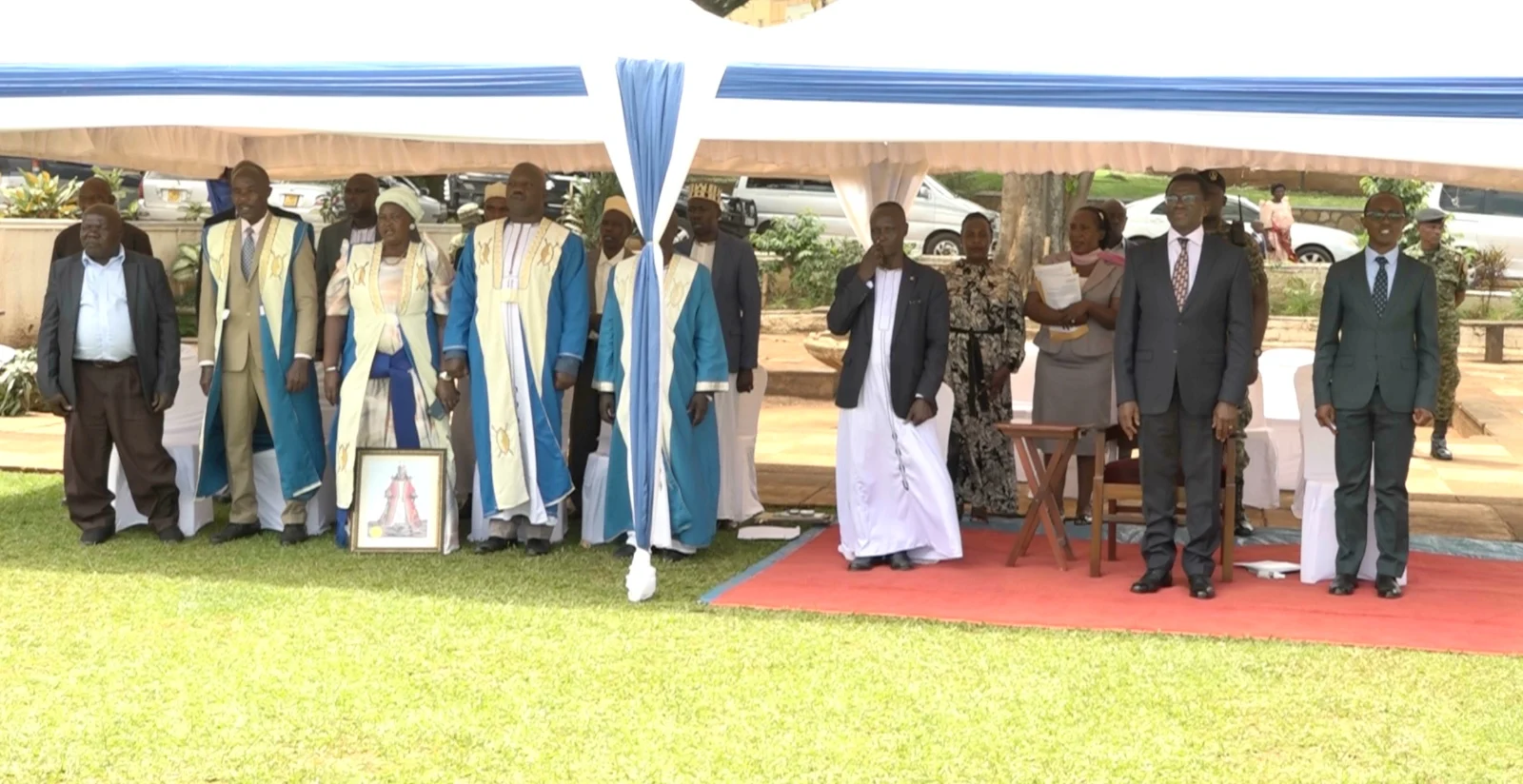
Buganda Kingdom’s Katikkiro Charles Peter Mayiga has brushed off critics of the kingdom’s development programs with characteristic wit and confidence. Speaking during the annual Luwalo community contribution event, the premier delivered a spirited defense of Buganda’s progress while rallying subjects to remain focused on economic empowerment initiatives.
“Buganda is awake and moving forward,” Mayiga declared to cheers from gathered residents of Buddu County. His remarks came as a direct response to those who have questioned the kingdom’s development campaigns like Mwanyi Terimba, the ambitious coffee revitalization program. “There are those bitter and jealous about our plans, but they will not succeed in pulling us down,” he stated, his voice carrying the conviction of someone who has spent twelve years championing the kingdom’s socioeconomic revival.
The Katikkiro’s defiance took musical form when he invoked Juliana Kanyomozi’s popular Luganda song “Kibaluma” – a symbolic choice whose lyrics about overcoming challenges resonated perfectly with his message. The Buddu crowd enthusiastically joined in the impromptu singing session, transforming the gathering into both a development meeting and cultural celebration.
Mayiga used the platform to deliver practical economic advice to Kabaka’s subjects. He urged residents to take full advantage of government programs like the Parish Development Model (PDM), stressing the importance of using such funds wisely to grow businesses. His message carried particular weight in Buddu, one of Buganda’s most active counties for coffee farming and grassroots mobilization.
“Why should we leave livestock farming to outsiders?” Mayiga questioned, challenging common perceptions about agricultural ventures. “Many Ugandans have lifted themselves from poverty through farming. Those who succeed are no different from us – they simply took initiative.” His words seemed aimed at breaking psychological barriers that sometimes prevent people from engaging fully in agricultural enterprises.
The third Deputy Pokino, Muwanga Dick, reinforced the Katikkiro’s coffee campaign message, confirming Buddu’s continued commitment to coffee growing. “Our people see coffee as their shield against poverty,” Muwanga stated, highlighting how the crop has become intertwined with the county’s economic identity.
This year’s Luwalo event demonstrated tangible progress in Buganda’s grassroots fundraising efforts. The four Buddu sub-counties present – Mutuba 7 Lwengo, Mutuba II Bigasa, Mutuba 23 Kyazanga, and Mutuba 13 Kisekka – collectively raised shs25 million during the gathering. Building on this momentum, Mayiga projected the kingdom would surpass last year’s shs1.6 billion total, potentially reaching shs2 billion this year.
The Katikkiro’s confidence stems from observable results of his twelve-year campaign to rally the kingdom toward economic self-sufficiency. Under his leadership, initiatives like Mwanyi Terimba have transformed from abstract concepts into concrete programs changing lives across Buganda. The Luwalo event itself – where communities voluntarily contribute to collective development – stands as evidence of this cultural-economic mobilization.
Mayiga’s remarks carried deeper significance beyond mere defiance of critics. They revealed a strategic leader who understands the power of narrative in development work. By framing Buganda’s progress as unstoppable and its critics as irrelevant, he creates psychological momentum that fuels participation in kingdom programs. His invocation of popular culture (through song) and emphasis on practical entrepreneurship (through PDM advice) demonstrate a nuanced approach to leadership in modern traditional institutions.
The Buddu gathering also showcased how Buganda’s development model blends traditional mobilization systems with contemporary economic strategies. Luwalo, an age-old concept of communal contribution, now funds modern agricultural enterprises. Kingdom officials work alongside government programs like PDM. Cultural symbols and songs motivate participation in cash crop farming. This fusion of old and new appears central to Mayiga’s vision for the kingdom.
As the event concluded, the message was clear: Buganda under Mayiga’s stewardship will continue its development path regardless of outside skepticism. The kingdom’s programs have moved beyond the conceptual phase into measurable impact – evidenced by growing coffee production, increasing Luwalo contributions, and visible economic activity across its counties. For the Katikkiro and Kabaka’s subjects, the focus remains fixed forward, with critics relegated to the background of a much larger story of cultural and economic revival.
The Luwalo gathering in Buddu ultimately served as both progress report and pep rally – assessing achievements while energizing participants for continued effort. In characteristic style, Mayiga turned criticism into motivation, transforming potential negativity into fuel for Buganda’s forward motion. As coffee plants grow across the kingdom and contribution totals rise year after year, even skeptics may find it increasingly difficult to argue with his confident declaration: “Buganda is awake and moving forward.”


 Achelam Jethro
 Happy Christine
 Gotcha News Uganda

 Kyalingabira Florence


 888starz_eroi

 Rory Muhame


 Nayebare Angel
